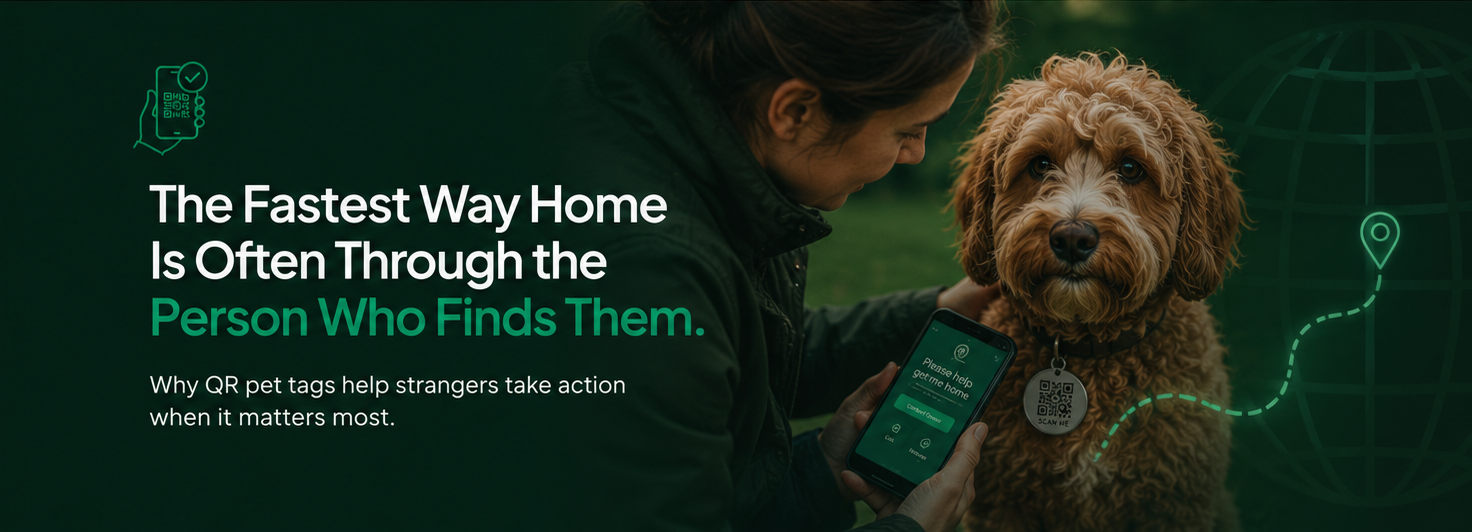
The fastest way home is often through the person who finds them
When a stranger is standing with your lost pet, the fastest route home isn't a map — it's making it easy for them to reach you.
GPS trackers are impressive technology. They can show movement, location, activity — a live map of where your pet is right now.
But there's a step that comes before all of that in most real-world reunifications: someone else finds your pet first.
Most lost pets are found by a person, not tracked by an owner
Think about how lost pets actually come home. A neighbour sees a dog loose near the road and picks them up. A cat turns up in a stranger's garden. A park visitor spots a dog wandering without an owner in sight. A vet, shelter or rescue centre takes a call from a member of the public.
In each of those situations, there's a window — a moment when a willing stranger has your pet and wants to help. What happens next depends almost entirely on how easy you've made it for them to act.
The finder needs one thing: a way to reach you
GPS answers the question "Where is my pet?" — which is useful when you're the one out searching.
But when a stranger is holding your pet, the question they're asking is different: "Who does this animal belong to, and how do I get them home?"
That's where friction becomes the enemy. Every extra step — finding a number, downloading an app, creating an account — is a reason for the reunion to slow down or stall. The easier you make it for the finder, the faster your pet comes home.
How a QR pet tag removes the barriers
With a Global Pet Register tag, a finder scans the QR code with any smartphone and goes straight to the pet's profile — your contact details, the pet's name, any important notes. No specialist equipment. No app. No account. Just a scan and a call.
That's the principle behind every GPR tag: make it as straightforward as possible for a willing stranger to do the right thing. Find out more in our guide to how GPR reunions work.
GPS helps you search. A QR tag helps the finder act. When your pet is found, every minute counts — and the last thing you want is a barrier between the person holding them and the call that brings them home. If you've found a pet, see exactly what to do next.